A father's journey using art, storytelling, and creativity to build communication and confidence in a child with autism.
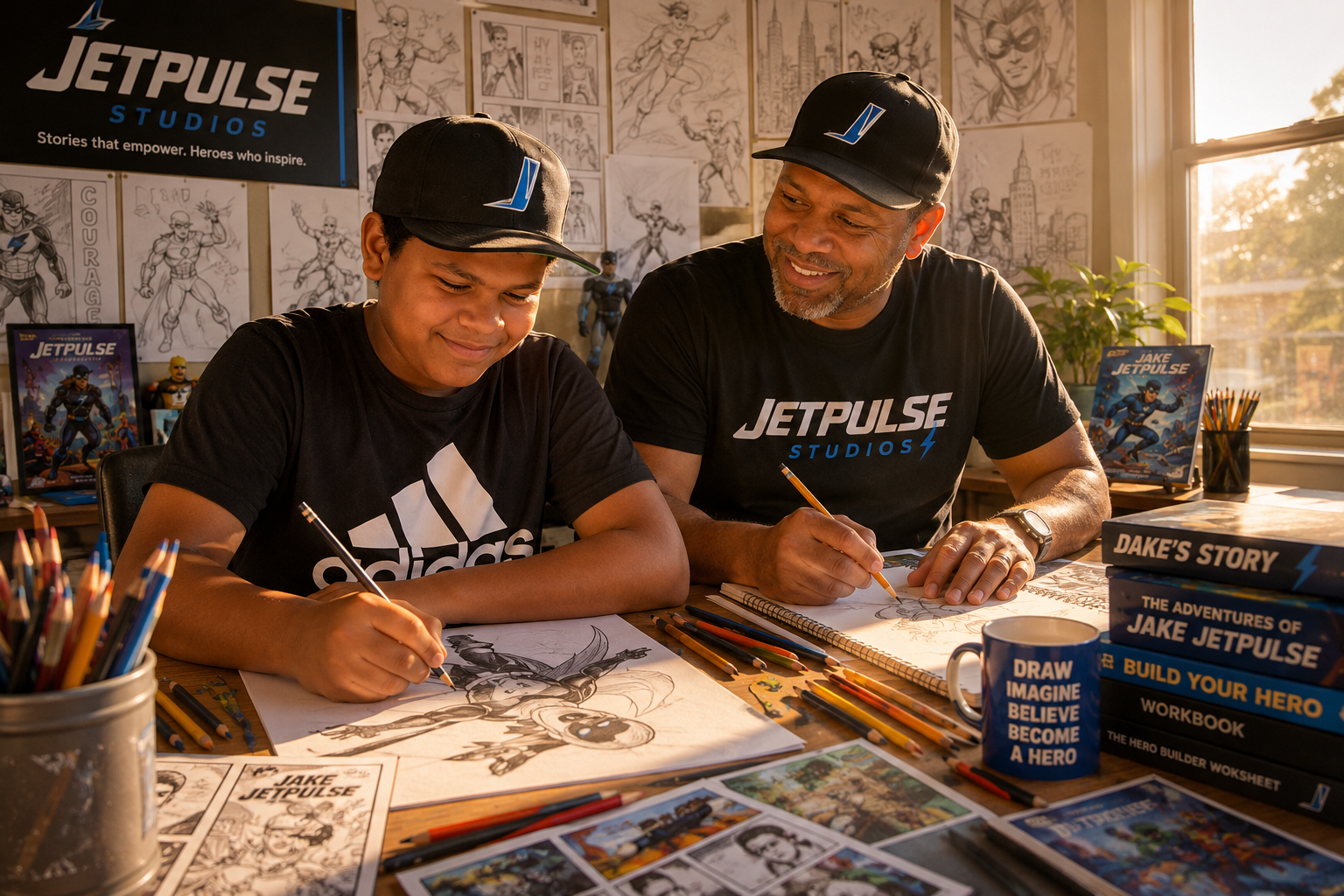
When my son Jake was diagnosed with autism at three and a half years old, I remember feeling like I had been handed a map written in a language I didn't understand.
Like many parents, I wanted answers.
I wanted a plan.
I wanted someone to tell me exactly what to do next.
Instead, I found myself navigating a world filled with evaluations, therapy appointments, recommendations, acronyms, and uncertainty.
What I didn't know at the time was that one of the most powerful tools for helping my son communicate, build confidence, and connect with the world wasn't something I would find in a clinic.
It was sitting on our kitchen table.
A pencil.
A sheet of paper.
And a child's imagination.
Today, people often ask me about art therapy for neurodivergent kids and whether drawing can really make a difference. While every child is unique, I can tell you this:
Drawing changed our lives.
This is the story of how creativity became one of the most powerful teaching tools in our home and how art helped my son find a voice when words were difficult.
What Is Art Therapy for Neurodivergent Kids?
Art therapy is the use of creative expression to support emotional, social, and cognitive development.
For neurodivergent children—including autistic children, children with ADHD, dyslexia, and other developmental differences—art can provide an alternative way to process thoughts and emotions.
Many children struggle to explain what they're feeling.
Some struggle to organize their thoughts.
Others become overwhelmed by language itself.
Art creates another pathway.
Instead of asking a child to explain something verbally, drawing allows them to show it.
Instead of demanding eye contact, conversation, or perfect communication, art meets children where they are.
That was certainly true for Jake.
The Early Signs
Before Jake was diagnosed, there were signs that something was different.
He didn't always respond to his name.
Eye contact was limited.
Conversations didn't develop the way we expected.
He often preferred playing alone.
He had intense interests and would return to them repeatedly.
As a parent, it's difficult to put into words what that period feels like.
You know your child is trying to communicate.
You know there is something beautiful happening inside their mind.
You just don't always know how to reach it.
When Jake received his autism diagnosis, we began pursuing services and supports. We explored different approaches and worked hard to help him develop communication skills.
But one thing happened naturally.
Jake gravitated toward superheroes.

The Power of Special Interests
Many autistic children develop deep interests in specific topics.
For Jake, those interests included superheroes, action figures, comic books, and imaginative storytelling.
At first, I viewed these interests the way many parents do.
They were things he enjoyed.
Things that made him happy.
What I eventually realized was that they were much more than that.
They were a bridge.
Instead of fighting against his interests, I started building on them.
If he loved superheroes, we talked about superheroes.
If he loved action figures, we used action figures.
If he loved stories, we created stories.
And that's where drawing entered the picture.
How Drawing Became Communication
When verbal communication was difficult, drawing gave Jake another way to express himself.
A superhero wasn't just a superhero.
It represented courage.
A battle scene wasn't just action.
It represented conflict, challenges, and problem-solving.
A character wasn't simply a character.
It was a reflection of thoughts, emotions, and ideas that might otherwise remain trapped inside.
I started noticing something remarkable.
When Jake drew, he focused.
When he drew, he communicated.
When he drew, he shared.
Drawing created opportunities for conversation that didn't exist before.
Instead of asking direct questions, I could ask about a character.
Instead of discussing emotions abstractly, we could talk about a hero's feelings.
The conversation became easier because it wasn't centered on Jake.
It was centered on the story.
Why Drawing Works for Many Autistic Children
Every autistic child is different, but there are several reasons why drawing can be such a powerful tool.
Visual Thinking
Many autistic individuals are visual thinkers.
Pictures often make more sense than spoken language.
Drawing allows ideas to exist in a visual form rather than requiring immediate verbal expression.
Reduced Pressure
Conversations can be demanding.
Drawing removes some of that pressure.
Children can create at their own pace without feeling rushed.
Emotional Expression
Feelings can be difficult to identify and communicate.
Art provides a safe outlet for emotional exploration.
Confidence Building
Success matters.
When children create something they're proud of, confidence grows.
Every completed drawing becomes evidence that they are capable of creating something meaningful.

Art Therapy Activities That Worked in Our Home
Parents often ask me where to start.
The good news is that you don't need expensive supplies or advanced artistic skills.
Some of our most meaningful moments happened with a pencil and a piece of paper.
Create a Superhero
Ask your child:
What is your hero's name?
What are their powers?
What challenges do they face?
Who do they help?
This activity encourages creativity while opening the door to conversations about strengths and challenges.
Draw Your Feelings
Instead of asking, "How do you feel?"
Try asking:
"What color is your feeling today?"
"What would your feeling look like?"
This can help children externalize emotions in a non-threatening way.
Hero vs. Villain
Create a hero and a villain.
Then discuss:
What does the villain represent?
What challenge must the hero overcome?
This often leads to meaningful discussions about fears, obstacles, and resilience.
Story Panels
Fold a page into four sections.
Create:
Beginning
Problem
Solution
Ending
This builds storytelling and sequencing skills while encouraging communication.
Design a Team
Have your child create a team of heroes.
Each hero can represent a different strength:
Courage
Kindness
Patience
Determination
Creativity
This can be a powerful exercise in self-discovery.
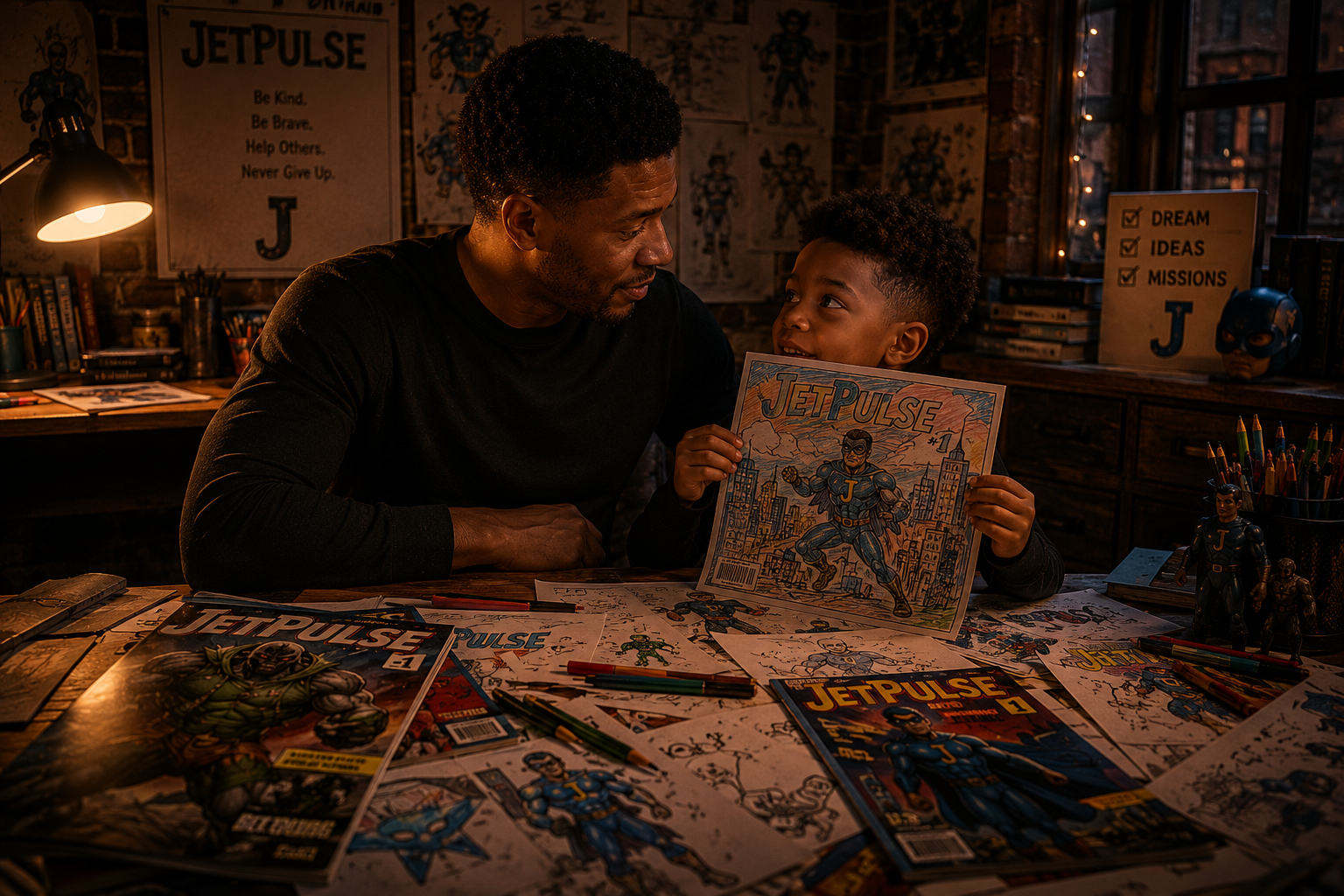
What Art Taught Me as a Parent
One of the biggest lessons I learned is that communication doesn't always look the way we expect.
As parents, we sometimes become focused on milestones.
We focus on speech.
We focus on behaviors.
We focus on what our children cannot yet do.
But creativity taught me to pay attention to what Jake could do.
And what he could do was extraordinary.
He could imagine.
He could create.
He could tell stories.
He could build entire worlds from a blank sheet of paper.
When I stopped focusing solely on deficits and started building on strengths, everything changed.
Art Became More Than Therapy
Over time, drawing evolved into something much bigger than an activity.
It became connection.
It became learning.
It became confidence.
It became a way for us to spend meaningful time together.
Some of our best conversations happened while sketching characters.
Some of our biggest breakthroughs happened while building stories.
What started as a creative outlet eventually became the foundation for books, comics, workshops, and educational resources.
It became the foundation for Jetpulse.
What began with a father trying to connect with his son eventually became a mission to help other families discover the power of creativity.

A Message to Parents
If you're searching for art therapy for autism or looking for ways to support a neurodivergent child, my advice is simple:
Start where your child already shines.
Don't worry about creating perfect artwork.
Don't worry about artistic talent.
Don't worry about making progress overnight.
Pay attention to what captures your child's imagination.
Follow their interests.
Build from their strengths.
The goal isn't to create great artists.
The goal is to create opportunities for connection.
Sometimes a drawing is just a drawing.
Sometimes it's a conversation.
Sometimes it's confidence.
Sometimes it's communication.
And sometimes it's the beginning of something much bigger.
Final Thoughts
Looking back, I realize that drawing didn't magically solve every challenge we faced.
Autism is still part of our journey.
Growth still takes time.
Life still presents obstacles.
But art gave us something invaluable.
It gave us a shared language.
A bridge.
A way to connect when words weren't enough.
If you're raising a neurodivergent child, I encourage you to explore creativity together.
Pick up a pencil.
Grab a piece of paper.
Create a character.
Tell a story.
You may discover, as I did, that some of the most important conversations happen long before a single word is spoken.
And sometimes, a child's greatest superpower begins with a simple drawing.
About the Author

Led Bradshaw is a father, author, illustrator, and the founder of Jetpulse Studios, an educational media company dedicated to helping children build confidence through creativity, storytelling, and visual learning. Inspired by his son Jake's autism diagnosis, Led developed a unique approach that combines art, superhero storytelling, and character creation to support communication, emotional growth, and self-expression.
Over the past several years, Led has created comics, workbooks, and educational resources used by families, educators, and neurodivergent learners. His family's journey has been featured by Good Morning America, The Today Show, News 12, Good Day New York, and other national media outlets. He is also the recipient of an Emmy Award for his work helping share Jake's story and advocating for autism awareness.
Through The Jetpulse, Led shares practical parenting insights, creative activities, and real-world strategies drawn from his experiences raising a son with autism. His mission is simple: help families discover their strengths, build confidence, and create meaningful connections through creativity.