A father's journey using superheroes, comics, and imagination to help his son communicate, connect, and grow.
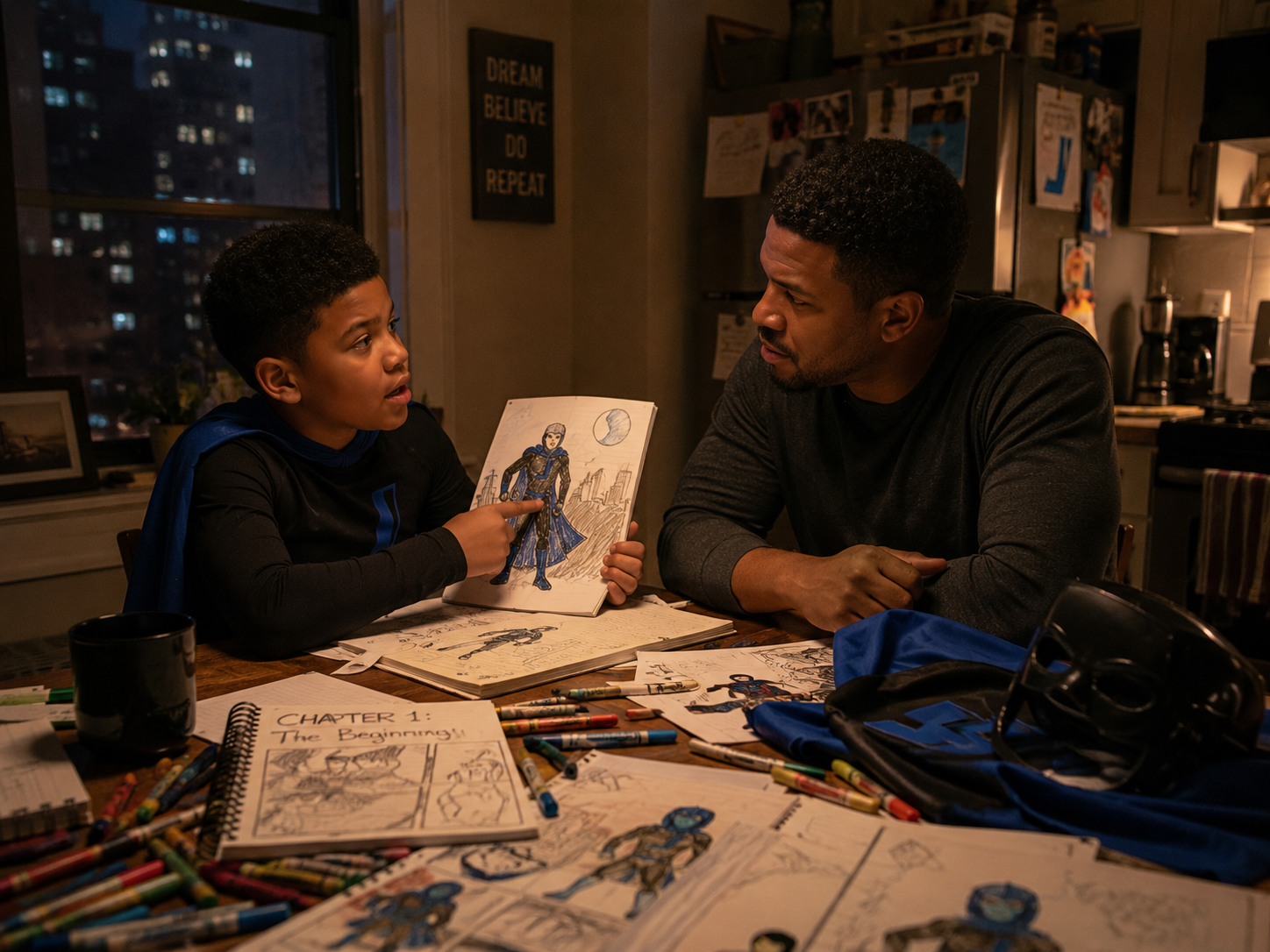
When my son Jake was diagnosed with autism at three and a half years old, communication became one of our biggest challenges.
Like many parents, I spent countless hours searching for ways to help him express himself, connect with others, and navigate a world that often felt overwhelming.
What I didn't expect was that one of the most powerful tools we would discover wasn't a therapy program, a workbook, or a specialized piece of technology.
It was storytelling.
Not storytelling as entertainment.
Storytelling as connection.
Storytelling as communication.
Storytelling as a bridge between my son's world and the world around him.
Looking back now, I realize that stories became one of the most effective ways to teach social skills, emotional awareness, confidence, and self-expression. In many ways, storytelling helped me understand my son just as much as it helped him understand the world.
If you're raising an autistic child, storytelling may become one of the most powerful tools in your parenting toolbox.
Why Storytelling Matters
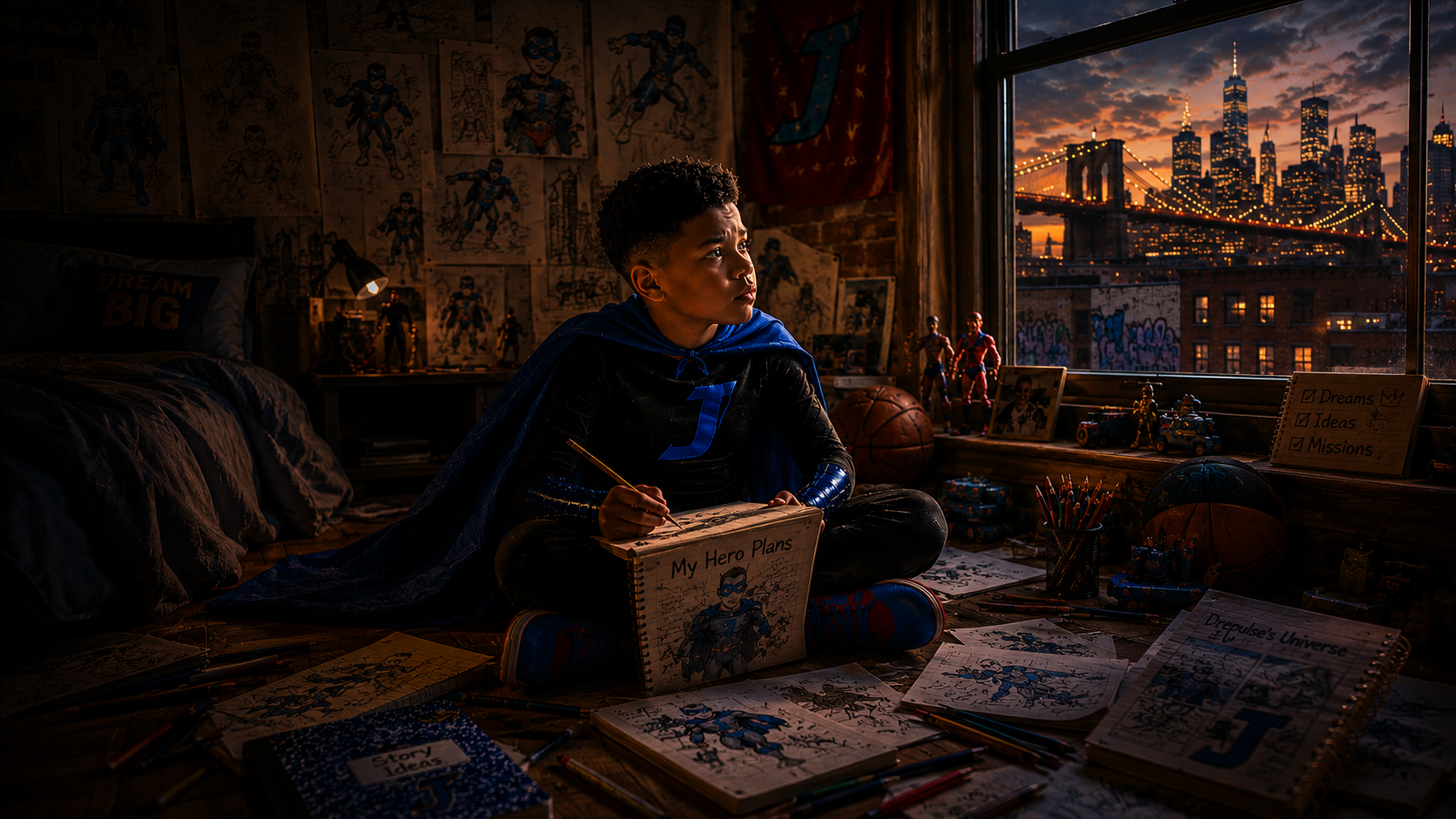
Human beings naturally make sense of life through stories.
We tell stories about our experiences.
We remember stories better than facts.
We use stories to explain emotions, relationships, and challenges.
Stories help us organize information into something meaningful.
For many autistic children, the world can sometimes feel confusing, unpredictable, or overwhelming.
Stories create structure.
Stories create patterns.
Stories create understanding.
A story has a beginning.
A middle.
An ending.
That predictability can make complicated ideas easier to understand.

Jake's First Stories
Long before Jake could explain his feelings in detail, he was creating stories.
At first, they revolved around superheroes.
Characters battled villains.
Heroes faced impossible odds.
Good triumphed over evil.
The stories were simple, but they revealed something important.
Jake wasn't just watching stories.
He was processing life through them.
Every character represented something.
Every challenge reflected a struggle.
Every victory reflected hope.
I began paying attention.
The more we talked about the characters, the more opportunities I had to understand what Jake was thinking.
Instead of asking difficult questions directly, I could ask about a hero.
Instead of talking about emotions in the abstract, we could discuss how a character felt.
The story became a safe place to explore ideas that were otherwise difficult to express.
Why Stories Feel Safe
Many autistic children experience anxiety when discussing personal emotions directly.
Questions like:
How are you feeling?
Why are you upset?
What happened today?
can sometimes feel overwhelming.
Stories provide distance.
When discussing a character, children often feel safer sharing thoughts and feelings.
A child may struggle to say:
"I'm scared."
But they might easily explain:
"The hero is scared because he doesn't know what will happen next."
The conversation is technically about the character.
But often, it reveals something deeper.
Storytelling Builds Communication Skills
One of the greatest benefits of storytelling is its ability to strengthen communication.
Every story requires:
Sequencing
Description
Problem solving
Cause and effect
Perspective taking
When children tell stories, they're practicing communication in a natural way.
Instead of memorizing social rules, they're actively using language to build meaning.
With Jake, I noticed that storytelling encouraged longer conversations.
He wanted to explain the hero's mission.
He wanted to describe the villain.
He wanted to tell me what happened next.
The story gave him a reason to communicate.
Stories Help Teach Emotions
Emotions can be difficult to identify and describe.
Many autistic children understand emotions differently than their neurotypical peers.
Stories provide examples.
Consider a superhero story.
The hero may experience:
Fear
Frustration
Excitement
Pride
Sadness
Courage
Through storytelling, children can observe emotions in action.
More importantly, they can discuss those emotions in a way that feels safe and engaging.
Instead of asking:
"Have you ever felt nervous?"
You can ask:
"Why do you think the hero feels nervous?"
The conversation often becomes richer and more meaningful.
The Power of Visual Storytelling
One thing I discovered early on is that storytelling doesn't always require words.
Many autistic children are visual thinkers.
Jake certainly was.
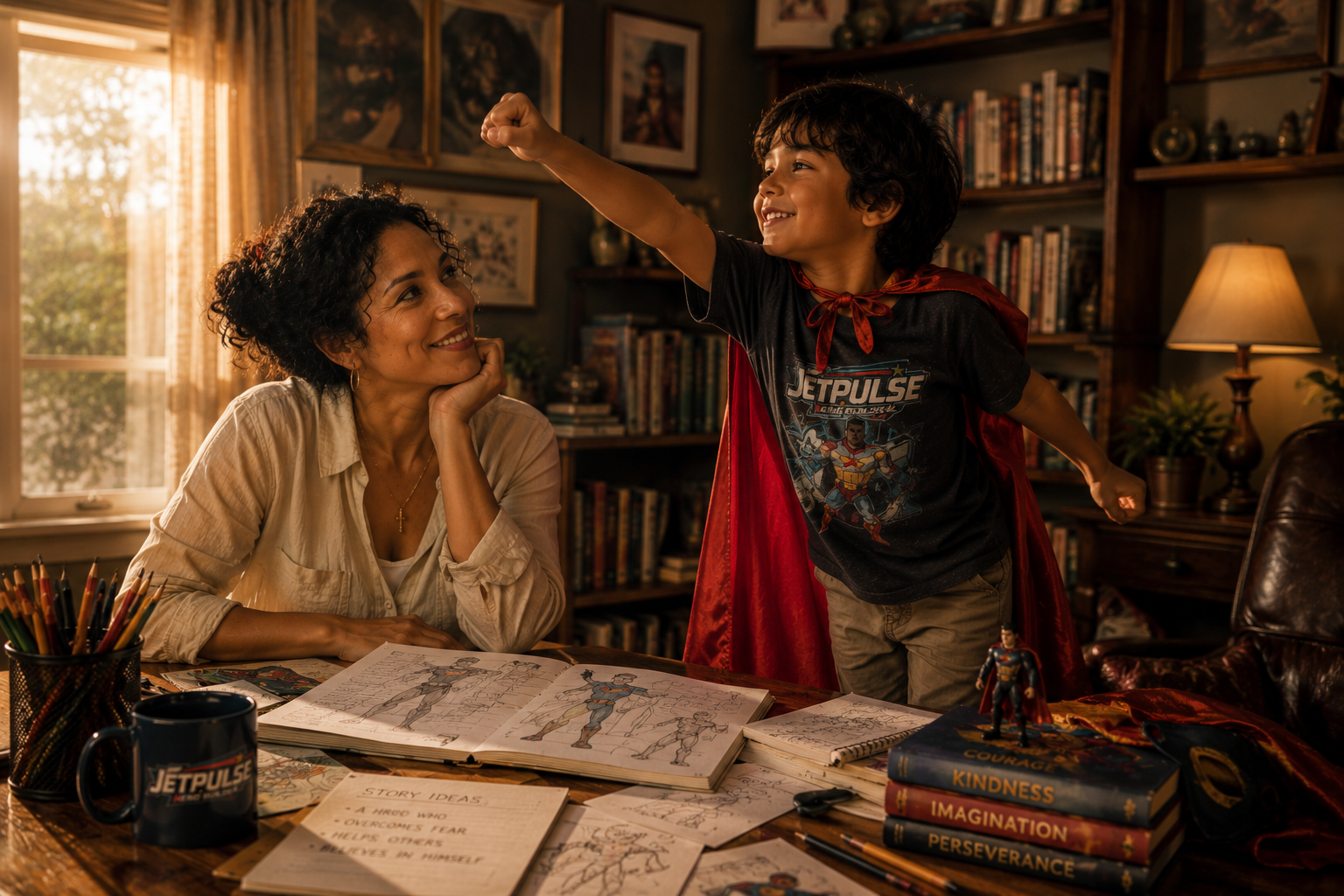
Drawing became a natural extension of storytelling.
A single image could spark an entire conversation.
A comic panel could communicate an idea that might take several paragraphs to explain.
Visual storytelling combines two powerful tools:
Art
Narrative
Together, they create opportunities for expression that feel accessible and enjoyable.
This is one of the reasons comics became such an important part of our journey.
How Superheroes Changed Everything
If you've followed our story, you know that superheroes played a major role in Jake's development.
At first, I simply saw them as an interest.
Later, I realized they were a teaching tool.
Every superhero story contains lessons.
Heroes face challenges.
Heroes make mistakes.
Heroes learn.
Heroes grow.
Heroes overcome obstacles.
Those themes mirror real life.
When Jake created his own heroes, he wasn't just drawing characters.
He was creating opportunities to explore confidence, resilience, friendship, and courage.
The stories became a framework for understanding the world.
Storytelling and Social Skills
Many social situations involve understanding perspective.
How does another person feel?
Why did someone react a certain way?
What happens next?
Stories naturally encourage these questions.
As children follow characters through challenges, they begin practicing perspective taking.
They consider motivations.
Consequences.
Choices.
Relationships.
Storytelling doesn't replace social interaction.
But it can create a foundation for understanding social situations in a way that feels engaging and meaningful.
Storytelling Activities for Autistic Children
Parents often ask me where to begin.
The good news is that storytelling can start with simple activities.
Create a Hero
Ask your child:
What's your hero's name?
What powers do they have?
What challenge do they face?
This encourages creativity and communication.
Finish the Story
Start a story and let your child finish it.
Example:
"One day, a young hero discovered a mysterious object..."
Then let them continue.
Draw a Story
Create a four-panel comic.
Beginning.
Problem.
Solution.
Ending.
Story Dice
Roll dice with pictures or prompts.
Use the images to build a story together.
Character Interviews
Pretend you're interviewing a character.
Ask questions about:
Goals
Fears
Friends
Adventures
Children often reveal surprising insights through their characters.
What Storytelling Taught Me
Perhaps the biggest lesson storytelling taught me is that communication comes in many forms.
Sometimes communication is verbal.
Sometimes it's visual.
Sometimes it's imaginative.
Sometimes it's hidden inside a story about a superhero saving the day.
As parents, we often focus on teaching children to communicate the way the world expects.
Storytelling reminded me to also appreciate the ways children naturally communicate.
When I stopped trying to force conversations and started following Jake's interests, everything changed.
The stories became the conversation.
The characters became the language.
The imagination became the bridge.

A Message to Parents
If your child loves superheroes, dinosaurs, trains, animals, video games, fantasy worlds, or any other special interest, don't dismiss it.
Lean into it.
Explore it.
Build stories around it.
Those interests may become powerful opportunities for learning and connection.
The goal isn't to create the next bestselling author.
The goal is to create opportunities for communication.
Stories simply happen to be one of the most enjoyable ways to do that.
Final Thoughts
When I look back on our journey, I realize that storytelling gave us more than creative memories.
It gave us connection.
It gave us understanding.
It gave us a shared language.
Every hero Jake created taught us something.
Every story opened a door.
Every character became another opportunity to communicate.
Today, storytelling remains one of the foundations of everything we do at Jetpulse.
Because stories aren't just entertainment.
Stories help us understand ourselves.
Stories help us understand each other.
And sometimes, a simple story can help a child find their voice.

Led Bradshaw is a father, author, illustrator, and the founder of Jetpulse Studios, an educational media company dedicated to helping children build confidence through creativity, storytelling, and visual learning. Inspired by his son Jake's autism diagnosis, Led developed a unique approach that combines art, superhero storytelling, and character creation to support communication, emotional growth, and self-expression.
Over the past several years, Led has created comics, workbooks, and educational resources used by families, educators, and neurodivergent learners. His family's journey has been featured by Good Morning America, The Today Show, News 12, Good Day New York, and other national media outlets. He is also the recipient of an Emmy Award for his work helping share Jake's story and advocating for autism awareness.
Through The Jetpulse, Led shares practical parenting insights, creative activities, and real-world strategies drawn from his experiences raising a son with autism. His mission is simple: help families discover their strengths, build confidence, and create meaningful connections through creativity.